Causes
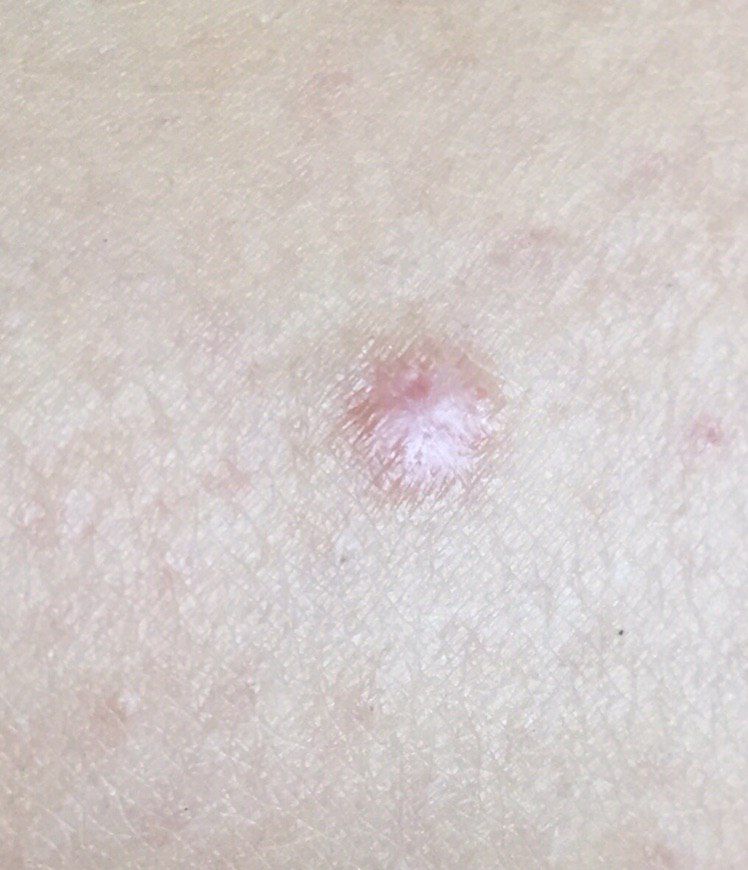
The exact cause of dermatofibroma is unknown, but it often develops at sites of minor skin injury like insect bites, scratches, or small cuts. Genetics, female sex, and repeated microtrauma may increase the chance of getting one.

Dermatofibroma
Frequency
Common
Age Group
Adults & Elderly
Progression
Self-Limiting
Contagious
No
Dermatofibroma is a common benign skin nodule made of fibrous tissue, usually appearing on the legs or shoulders. It grows slowly, often stays small, and almost never turns into cancer, but it can be mistaken for more serious tumors, so proper diagnosis is important.
This is general information. With a scan you'll receive a detailed, personalized analysis — including individual risk assessment, progression tracking and recommended actions.
The exact cause of dermatofibroma is unknown, but it often develops at sites of minor skin injury like insect bites, scratches, or small cuts. Genetics, female sex, and repeated microtrauma may increase the chance of getting one.
Dermatofibromas are considered safe and have an extremely low risk of turning into cancer. The main risks are cosmetic concerns, confusion with more serious tumors, and irritation from constant rubbing or injury.
If a dermatofibroma is typical and not bothering you, no treatment is needed. When removal is desired or there is any doubt about the diagnosis, the best option is surgical excision with histology; laser or freezing methods are not recommended because of higher recurrence.
The information provided here is for educational purposes only and does not replace professional medical advice. Always consult a dermatologist or physician if you have any concerns.
An open comedone, or blackhead, is a small plug of oil and dead skin that blocks the opening of a pore and turns dark when exposed to air. It is a non‑inflamed form of acne and most often appears on the face, neck, chest, back, and shoulders. Blackheads are usually harmless but can be a cosmetic concern and may progress to inflamed pimples if bacteria overgrow.
Milia are tiny, white or yellowish cysts just under the surface of the skin, most often seen on the face. They are harmless, not infectious, and usually cause only cosmetic concerns rather than health problems.
There is no guaranteed way to prevent dermatofibromas, but protecting your skin from repeated minor injuries may lower the chance of new ones. Regular self‑checks, gentle skin care, and timely review of any changing bumps are the most practical steps.
See a dermatologist if a suspected dermatofibroma changes in size, color, or shape, becomes painful, bleeds, or if you are simply not sure about the diagnosis. Routine monitoring with our AI skin analysis is fine for stable, typical lesions, but any doubt should be checked in person.
Dermatofibromas are low‑urgency lesions, and most can be checked at a routine dermatology visit rather than urgently. Seek earlier evaluation if the bump changes quickly, becomes painful, bleeds, or looks clearly different from your other skin spots.
A closed comedone (whitehead) is a small clogged pore where sebum and dead skin cells are trapped under a thin layer of skin. It looks like a tiny, pale or skin‑colored bump without a black dot in the center and is considered a mild, non‑inflamed form of acne.