
What Is Vitiligo and What Causes It?
Vitiligo is an acquired chronic skin condition characterized by the progressive loss of melanocytes — the pigment-producing cells in the skin — resulting in well-defined patches of depigmented (white) skin. 5-2% of the global population across all ethnicities and skin types, though it is more visually apparent and often more psychologically impactful in individuals with darker skin tones where the contrast between affected and unaffected skin is greater. Vitiligo can develop at any age but most commonly appears before age 30, with about half of cases developing before age 20.
The underlying cause is autoimmune destruction of melanocytes. The immune system — specifically autoreactive CD8+ T cells — mistakenly identifies melanocytes as foreign and attacks them, destroying the cells that produce melanin pigment. Why the immune system targets melanocytes is not fully understood, but the process involves a combination of genetic susceptibility, environmental triggers, and oxidative stress within melanocytes themselves.
Genetic factors contribute significantly: vitiligo runs in families, and genome-wide association studies have identified over 50 susceptibility loci, many shared with other autoimmune diseases. Approximately 15-25% of vitiligo patients have at least one other autoimmune condition — most commonly autoimmune thyroid disease (Hashimoto's thyroiditis or Graves' disease), but also type 1 diabetes, alopecia areata, pernicious anemia, Addison's disease, and rheumatoid arthritis. This clustering underscores vitiligo's nature as a systemic autoimmune condition with skin manifestations rather than a simple cosmetic concern. Environmental triggers that may initiate or worsen vitiligo in genetically predisposed individuals include physical trauma to the skin (the Koebner phenomenon, where new vitiligo patches develop at sites of injury, friction, or sunburn), emotional stress, and chemical exposures (certain phenol derivatives in hair dyes, rubber, and adhesives can trigger occupational vitiligo).

Types of Vitiligo: Segmental vs. Non-Segmental
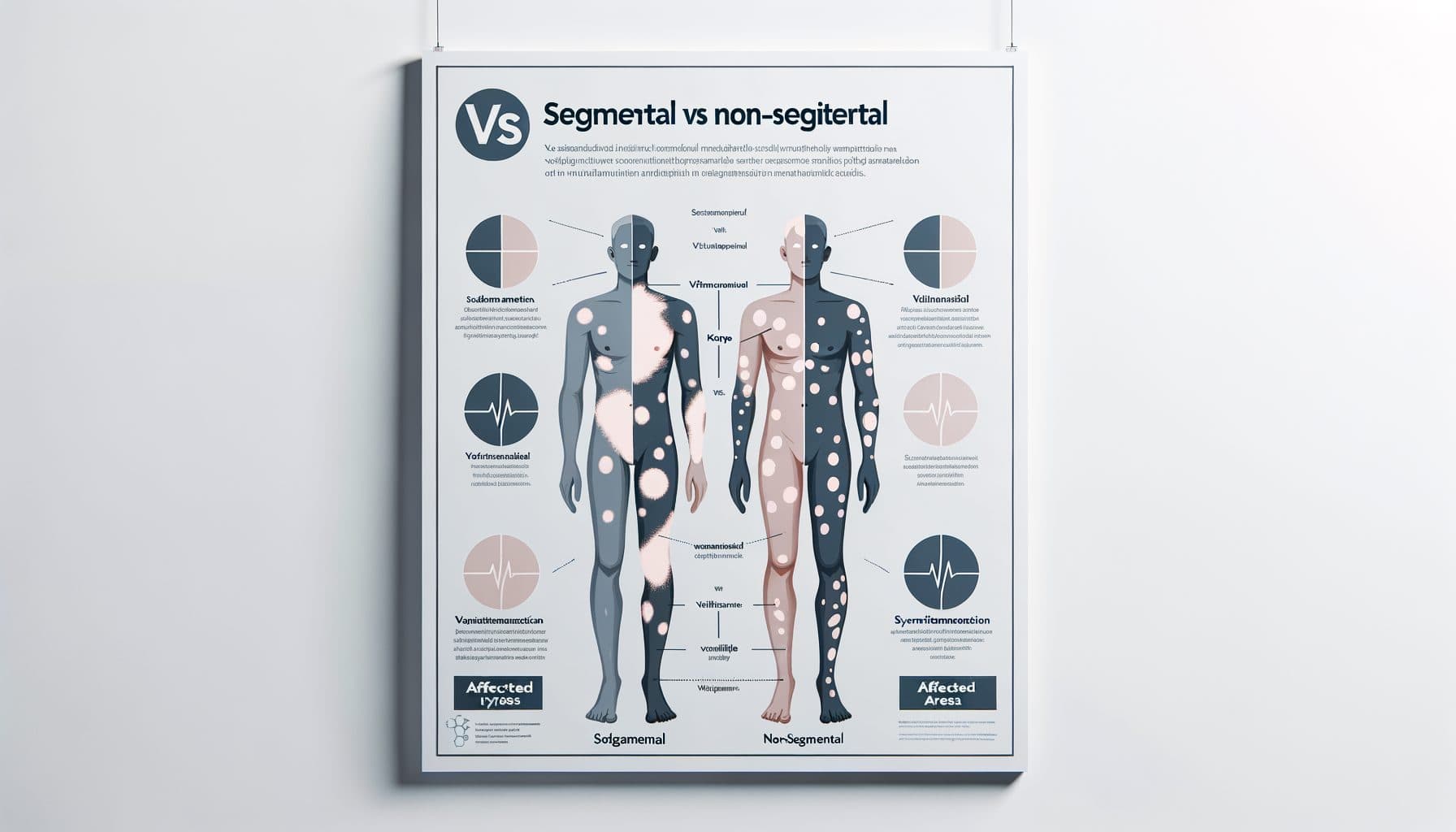
Vitiligo is classified into two major types with distinct clinical behaviors and prognostic implications. Non-segmental vitiligo (NSV), also called generalized vitiligo, accounts for approximately 85-90% of cases. It typically presents with bilateral, symmetrical patches of depigmentation that appear on both sides of the body in corresponding locations — both hands, both knees, both sides of the face.
NSV tends to be progressive and unpredictable, with periods of stability alternating with episodes of rapid spread. Common distribution patterns include acrofacial (fingers, toes, and facial orifices), generalized (widely scattered patches), and universal (extensive depigmentation covering most of the body surface). NSV may continue to develop new patches throughout life, though the rate of progression varies enormously between individuals.
Segmental vitiligo (SV) accounts for approximately 10-15% of cases and behaves very differently. It appears as depigmented patches restricted to one segment or area of the body, often following a pattern corresponding to a dermatome (an area of skin supplied by a single spinal nerve). SV typically has an early, rapid onset, stabilizes within 6-24 months, and then remains stable without further spread — it does not evolve into generalized disease.
The underlying mechanism may differ from NSV, involving localized neural or sympathetic nervous system dysfunction rather than purely autoimmune melanocyte destruction. SV responds differently to treatment: it is less responsive to medical therapies but is an excellent candidate for surgical repigmentation techniques because the disease is stable. Mixed vitiligo, where both segmental and non-segmental patterns coexist, occurs in a small percentage of patients.
Focal vitiligo describes one or a few isolated patches that don't fit a segmental or generalized pattern — it may remain focal indefinitely or eventually evolve into non-segmental disease. The distinction between types is clinically important because it influences treatment selection, prognosis, and expectations for disease progression.
Treatment Options: From Light Therapy to JAK Inhibitors
Vitiligo treatment aims to halt disease progression and restore pigmentation to depigmented areas. No treatment works for everyone, and repigmentation is typically slow and partial, requiring patience and realistic expectations. Topical corticosteroids are first-line treatment for limited, early, and active vitiligo.
Potent topical steroids (betamethasone, clobetasol) can halt progression and promote repigmentation, particularly in facial and body patches when used early. Treatment duration should be limited (typically intermittent use, such as 2 weeks on, 2 weeks off) to minimize side effects like skin thinning. Topical calcineurin inhibitors (tacrolimus, pimecrolimus) are steroid-sparing alternatives particularly useful for facial and eyelid vitiligo where long-term steroid use is inadvisable.
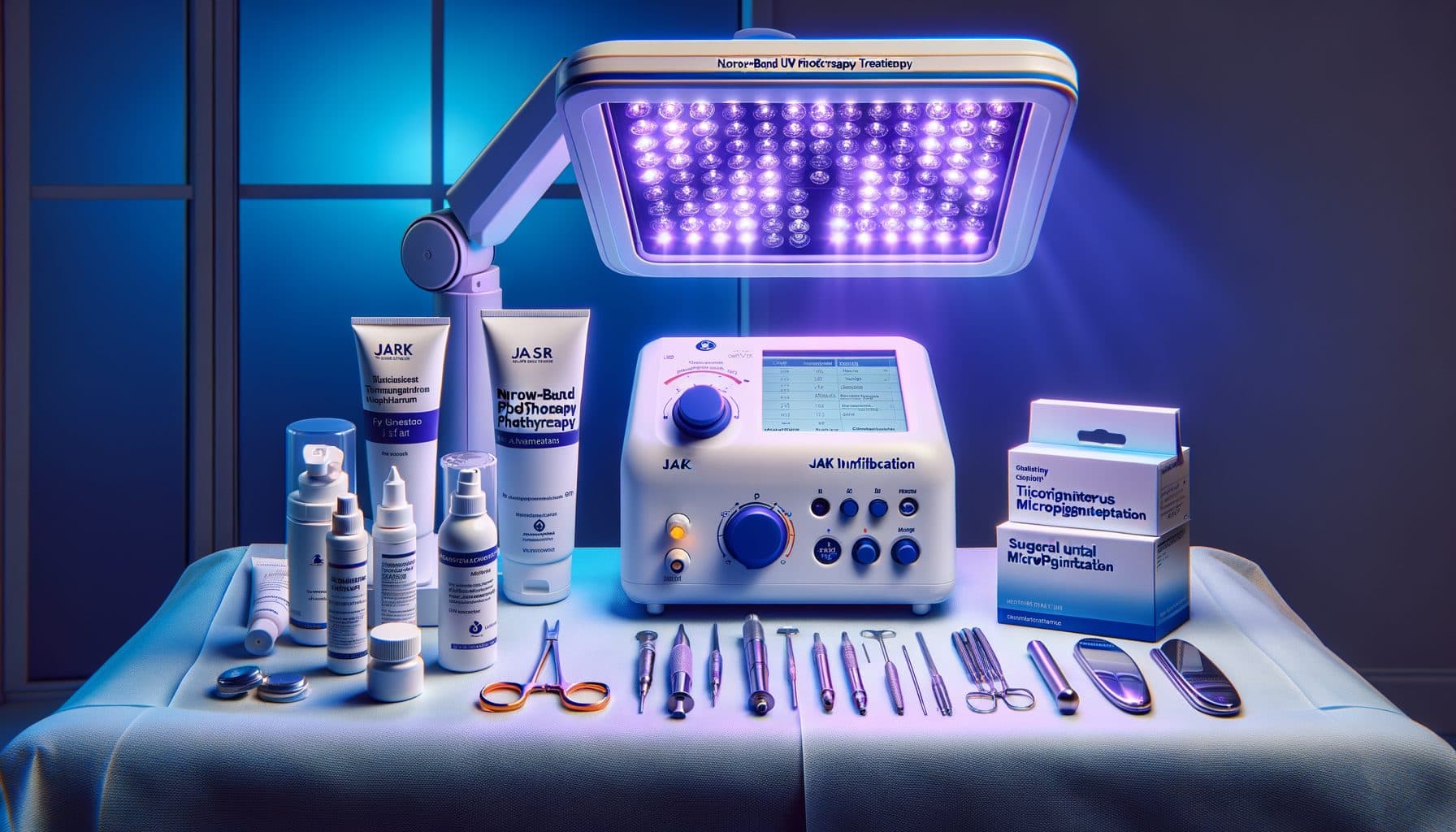
They are safe for prolonged use and have shown efficacy comparable to topical steroids for facial vitiligo. Phototherapy is the cornerstone of treatment for more widespread vitiligo. Narrowband UVB (NB-UVB) light therapy, delivered 2-3 times weekly for 6-12 months or longer, is the most effective and widely used phototherapy modality.
It works by stimulating melanocyte stem cells in hair follicles to migrate to the surrounding skin and produce pigment — this is why repigmentation typically begins as small pigmented spots (perifollicular repigmentation) around individual hair follicles, gradually expanding and coalescing. Response rates vary: facial and neck vitiligo responds best (up to 75% repigmentation in responsive patients), while hands, feet, and bony prominences respond poorly due to fewer hair follicles and therefore fewer melanocyte stem cell reservoirs. Home NB-UVB units allow treatment without clinic visits, improving compliance for long-term therapy.
The most exciting recent development is the FDA approval of ruxolitinib cream (Opzelura), a topical JAK inhibitor, specifically for vitiligo. JAK inhibitors work by blocking the JAK-STAT signaling pathway that drives the autoimmune attack on melanocytes. In clinical trials, ruxolitinib cream achieved significant facial repigmentation in approximately 30% of patients at 24 weeks, with continued improvement over 52 weeks.
This represents a paradigm shift — the first targeted therapy approved specifically for vitiligo. Oral JAK inhibitors (tofacitinib, baricitinib, ritlecitinib) have shown impressive results in clinical trials and case series, particularly for rapidly progressive vitiligo, though they are not yet specifically approved for this indication and carry systemic side effect profiles that require monitoring. Surgical treatments — including suction blister grafting, split-thickness skin grafting, and melanocyte-keratinocyte transplantation — are options for stable vitiligo (no new patches for at least 12 months) that has not responded to medical therapy. These procedures transplant melanocytes from normally pigmented donor skin to depigmented areas.
The Psychological Impact: More Than Skin Deep
Vitiligo's impact on psychological wellbeing and quality of life is profound and medically recognized, yet historically underacknowledged. Depigmentation of visible areas — face, hands, arms — fundamentally alters appearance in a way that is both permanent and progressive, creating ongoing adjustment challenges that differ from conditions with intermittent symptoms. Research consistently demonstrates significantly elevated rates of depression, anxiety, low self-esteem, and social avoidance in vitiligo patients compared to the general population and even compared to patients with other skin conditions.
The impact is modulated by several factors: extent and location of depigmentation (facial involvement is most distressing), skin tone (higher contrast between affected and unaffected skin increases visibility and distress), age of onset (adolescent onset affects identity formation during a vulnerable period), gender (some studies show higher psychological impact in women, though men are also significantly affected), and cultural context (societies that associate skin color with identity, purity, or beauty add stigmatic burden). Children with vitiligo face bullying, social exclusion, and the cruelty of peers who don't understand the condition. Adolescents may withdraw from social activities, dating, and sports that expose their skin.
Adults report workplace discrimination, strained relationships, sexual avoidance, and limitation of daily activities to minimize skin exposure. The concept of camouflage plays an important role for many patients: cosmetic coverage using specialized medical camouflage products, self-tanners applied to depigmented areas, and makeup techniques that match skin tones can provide significant psychological relief and functional improvement in daily life. These are not vanity measures but practical tools that improve quality of life during the often lengthy treatment process.
Professional mental health support should be considered an integral part of vitiligo management, not an afterthought.!! Cognitive-behavioral therapy, acceptance and commitment therapy, and support groups (both in-person and online) provide valuable coping strategies and reduce isolation. Dermatologists managing vitiligo should routinely screen for psychological distress and facilitate appropriate referrals.

Living with Vitiligo: Sun Protection and Daily Management
Daily management of vitiligo involves protecting depigmented skin from sun damage, maintaining treatment consistency, and adapting to the aesthetic and social challenges the condition presents. Sun protection is particularly important for people with vitiligo: depigmented skin lacks the natural UV protection that melanin provides, making it significantly more susceptible to sunburn and potentially to long-term UV damage including skin cancer risk. Broad-spectrum sunscreen (SPF 30 or higher) must be applied daily to all depigmented areas and reapplied every two hours during outdoor exposure.!!
Sun-protective clothing with UPF ratings provides reliable protection. Additionally, sunburn can trigger the Koebner phenomenon, causing new vitiligo patches at sites of sun damage — a double reason for diligent protection. Paradoxically, controlled UV exposure through prescribed phototherapy is a treatment for vitiligo, so the message is not total sun avoidance but controlled, purposeful UV exposure under medical guidance combined with diligent protection of depigmented skin during uncontrolled sun exposure.
For cosmetic management, waterproof cosmetic camouflage products (Dermablend, Covermark) can effectively conceal depigmented patches for social and professional situations. Dihydroxyacetone-based self-tanners can temporarily darken depigmented skin, though achieving a natural color match requires experimentation. Micropigmentation (cosmetic tattooing) can provide semi-permanent color to small, stable areas like lips, though color matching is challenging and the results may change over time as the tattoo fades or surrounding skin tone changes. For patients who have lost the majority of their pigmentation, depigmentation of the remaining pigmented skin using monobenzone cream creates a uniform skin tone — this irreversible decision requires careful consideration and counseling but provides aesthetic uniformity for those with extensive, treatment-resistant vitiligo.

When to See a Doctor About Skin Color Changes
Any new or expanding areas of skin depigmentation warrant medical evaluation. While vitiligo is the most common cause of acquired depigmentation, other conditions must be ruled out: tinea versicolor (a fungal infection causing lighter patches), pityriasis alba (mild eczema causing pale patches, common in children), chemical leukoderma (depigmentation from contact with specific chemicals), post-inflammatory hypopigmentation (lighter skin following resolved eczema, psoriasis, or injury), and rarely, hypopigmented mycosis fungoides (a form of cutaneous lymphoma). A dermatologist can usually diagnose vitiligo clinically, often aided by a Wood's lamp examination (ultraviolet light that makes depigmented patches fluoresce bright white, distinguishing true depigmentation from hypopigmentation).
Skin biopsy is rarely needed but may be performed to exclude other diagnoses. Given the association between vitiligo and other autoimmune conditions, newly diagnosed patients should be screened for thyroid disease (thyroid function tests and anti-thyroid antibodies), as this is the most common associated condition. Screening for other autoimmune markers may be warranted based on symptoms. If you have existing vitiligo and notice rapid expansion of patches, new patches appearing at sites of skin injury (Koebner phenomenon), or patches in new body areas, see your dermatologist promptly — active, spreading disease may benefit from systemic treatment to halt progression.

How AI Skin Analysis Can Help Monitor Vitiligo
Vitiligo treatment response is slow and often subtle, making objective documentation essential for tracking progress and treatment decisions. Skinscanner provides an accessible tool for regular photographic documentation of your vitiligo, creating visual records that reveal gradual repigmentation (or progression) that daily observation misses. By photographing affected areas under consistent lighting conditions at regular intervals — monthly during active treatment — you build a timeline that objectively demonstrates whether your current treatment is producing results.
This is particularly valuable for phototherapy, where perifollicular repigmentation (tiny dots of pigment returning around hair follicles) represents early treatment response that can be difficult to appreciate without photographic comparison. For those using topical treatments like ruxolitinib cream, comparing photographs before treatment to those at 12, 24, and 52 weeks provides concrete evidence of treatment efficacy. This documentation is invaluable for dermatology appointments, helping your provider assess whether to continue current therapy, adjust dosing, or switch approaches.
Skinscanner can also help detect new areas of depigmentation early, allowing prompt treatment of active disease before patches become large and more difficult to treat. While AI analysis cannot diagnose vitiligo or prescribe treatment, it empowers you with objective documentation that supports more informed treatment decisions and demonstrates the gradual improvements that maintain motivation through the long treatment journey.